The duplex at 2330 West Hope Avenue in Milwaukee, Wisconsin, built in 1929, is a brick multi-family home that reflects the city’s long history of early 20th-century residential development. Like many duplexes from this era, it was designed to efficiently house two separate households under one roof while maintaining solid craftsmanship and durability. Despite visible signs of age and neglect, the structure still carries the strength and character typical of historic Midwestern construction, making it a recognizable piece of Milwaukee’s architectural landscape.
The property offers approximately 2,358 square feet of living space with four bedrooms and two bathrooms across two units. Its layout allows for flexible use, whether as an owner-occupied home with rental income from the second unit, a multi-generational living arrangement, or a full investment property. Additional features such as a full basement and a detached two-car garage add practical value, providing storage, utility space, and convenient off-street parking. The compact lot also allows for low-maintenance outdoor use while still offering room for small landscaping or gathering areas.
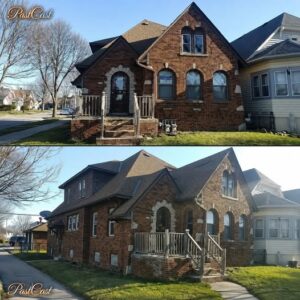
As a city tax foreclosure, the home is being sold in as-is condition with a clearly defined scope of essential repairs, estimated at roughly $13,830, with broader projected work around $21,130. While the property requires significant renovation—including potential updates to electrical, plumbing, interiors, and structural elements—it also presents an opportunity for restoration and customization. Buyers interested in historic homes often see value in preserving original features while modernizing the space for contemporary living, turning a distressed property into something functional and visually appealing again.
Overall, the duplex represents both challenge and opportunity. It is not move-in ready and demands time, planning, and financial commitment, but it also offers long-term potential for homeowners or investors willing to take on a renovation project. With its solid brick construction, flexible layout, and location within Milwaukee’s established housing stock, the property could become a valuable asset once restored. For the right buyer, it is less about its current condition and more about the possibilities it holds for the future.