Joey Moorman’s performance on Wheel of Fortune serves as a compelling case study in the difference between cumulative skill and high-pressure recall. Having already secured over $22,000 and a trip to the Cook Islands through consistent, strategic play, Joey entered the Bonus Round with significant momentum. However, the Bonus Round functions as a psychological reset, isolating a single ten-second window where previous success offers no protection. Despite his self-described love for adrenaline-fueled activities, the mental intensity of a timed word puzzle proved to be a unique form of stress that even extreme sports could not replicate.
The puzzle “BE_ _E WOOL CO_T” appeared deceptively simple to those watching from home, but for Joey, standing under the studio lights, the environment became a cognitive trap. Under intense pressure, the human brain often fails to retrieve common information in a linear fashion, instead prioritizing emotional urgency or locking onto incorrect patterns. While Joey vocalized various guesses, the word “beige”—a common part of everyday vocabulary—remained inaccessible within the brief ten-second limit. This phenomenon is a well-documented cognitive misfire where stress narrows attention and disrupts working memory, making retrieval nearly impossible until the pressure is removed.
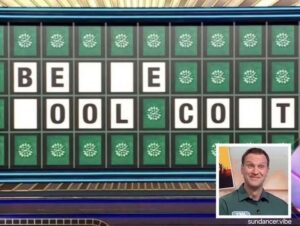
When the clock expired and the $40,000 prize vanished, the reveal of the answer highlighted the stark disconnect between knowledge and access. The audience and viewers at home experienced a sense of disbelief because the answer seemed obvious in hindsight, yet for the contestant, the moment was defined by a specific type of mental paralysis. This event underscores a universal truth about high-stakes decision-making: success often depends less on what one knows and more on the ability to access that knowledge at a precise, fleeting moment. Despite the loss, Joey’s experience remains a humanizing reminder of how time and consequence can distort even the simplest tasks.