People who carefully look at paper money from time to time may notice strange markings stamped on certain bills. These can include tiny symbols, stars, arrows, numbers, or unfamiliar characters on United States currency, which often makes people curious about whether the marks have a secret purpose. Since they are not part of the original printed design, the stamps may appear suspicious or unusual at first. However, in most cases, these markings have a simple explanation related to the way U.S. dollar bills circulate around the world.
These markings are called “chop marks,” a practice commonly connected to international trade and currency exchange. In countries where counterfeit money is a major issue, merchants, money exchangers, and financial workers often inspect foreign bills carefully before accepting them. Once a bill’s texture, watermark, security features, and overall authenticity have been checked, some people add a small stamp or symbol to show that the note has already been verified. This process helps create trust in fast-paced transactions, especially in crowded markets where cash is exchanged constantly throughout the day.
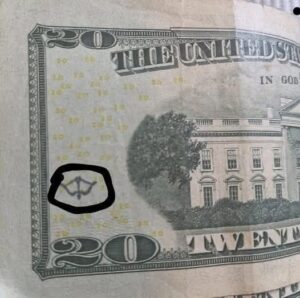
The use of chop marks dates back hundreds of years, long before paper money became widely used. In the past, traders in parts of Asia and along important trade routes marked silver coins to confirm their quality and authenticity. As commerce expanded and paper currency became more common, the custom of marking verified money gradually shifted from coins to banknotes. Since the United States Dollar is one of the most widely circulated currencies worldwide, it is also one of the currencies most frequently marked in this way.
Even though bills with many chop marks can sometimes cause problems for vending machines or self-checkout scanners, they are usually still considered valid as long as the serial numbers and key security features are visible. Many people actually find these marked bills interesting because they reveal the long international journey currency can take. A tiny stamp on a dollar bill may represent years of movement through different countries, cultures, and economies. What may initially seem mysterious is often simply a reminder of how interconnected the world has become.