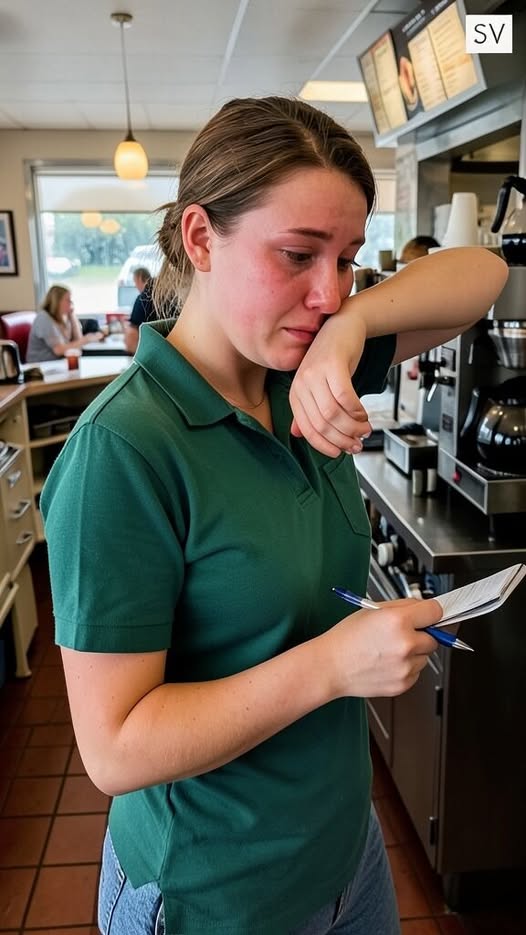
For months, our Fridays followed a rhythm so steady it felt almost sacred. The café wasn’t particularly large or remarkable, but it held a kind of warmth that made people linger longer than they intended. I would take my usual seat in the corner, close enough to observe but far enough not to interfere, and watch my seventeen-year-old daughter, Maya, move gracefully between tables. There was something quietly remarkable about her presence—she carried herself with a calm confidence that didn’t demand attention but naturally earned respect. She had taken the job without hesitation when my knee surgery left me unable to work the long hours I once did. I had argued at first, insisting she focus on school, on being young, on not carrying burdens too early. But she had simply smiled in that steady, knowing way of hers and said, “We’ll get through it together.” And she meant it. Every tray she carried, every order she wrote down, every polite smile she offered—it all spoke of a strength that had grown quietly within her, shaped not by ease, but by responsibility. Watching her, I often felt a mix of pride and something deeper, something humbling. She wasn’t just helping; she was becoming someone resilient in ways I couldn’t have taught through words alone.
Among the regulars, there was one couple I couldn’t help but notice. They came in like clockwork, always choosing the same table near the window. The husband had a quiet demeanor, the kind of man who nodded politely and rarely spoke more than necessary. But his wife—she was different. There was a sharpness to her tone, a habit of noticing imperfections others might overlook. At first, her comments seemed harmless, almost routine—remarks about coffee temperature, the speed of service, the arrangement of utensils. But over time, those remarks grew more pointed, more personal. I saw how her voice would rise just enough to draw attention, how her words lingered longer than they needed to. Yet Maya never reacted defensively. She listened, apologized when necessary, and responded with the same calm respect she offered everyone else. It wasn’t submission; it was composure. Still, I could see the toll it took in the small details—the brief pause before she approached their table, the slight tightening of her shoulders, the way she exhaled afterward as if releasing tension she refused to show. I wanted to step in more than once, to shield her from that unnecessary harshness, but I held back. Part of me knew that what she was learning in those moments—patience, restraint, grace under pressure—was shaping her in ways that mattered far beyond that café.
The day everything shifted began like any other busy afternoon. The café was full, conversations overlapping, dishes clinking, the air filled with the comforting chaos of a place alive with activity. Maya moved quickly but never seemed rushed, balancing efficiency with attentiveness. I had just taken a sip of my coffee when I noticed the familiar tension building at the window table. The woman’s voice carried across the room, sharper than usual, her words no longer contained to a private complaint. It was something small, something that would normally pass unnoticed, but she magnified it, turning it into a spectacle. Heads turned. Conversations softened. The atmosphere shifted from lively to uneasy. I felt a surge of protectiveness rise in me, instinctively pushing my chair back as I prepared to intervene. There’s a point, as a parent, where patience gives way to action, where watching quietly no longer feels right. But before I could take a single step, something unexpected happened—something that changed the entire tone of the moment in a way I could never have anticipated.
The husband, who had always remained in the background, suddenly stood up. His movement alone was enough to draw attention, but it was the calm authority in his voice that truly silenced the room. He didn’t raise it. He didn’t match his wife’s intensity. Instead, he spoke with a steadiness that cut through the tension like a quiet truth finally being acknowledged. At first, he simply asked her to stop. There was a gentleness in his words, but also a firmness that suggested this wasn’t the first time he had felt the need to say it. When she continued, dismissing his request, something shifted in his expression. He spoke again, this time with a clarity that seemed to carry more than just the present moment. He began to share something personal—something from their past that none of us knew, something that connected, in an unexpected way, to the situation unfolding before us. He spoke of a time they had struggled to understand someone close to them, a time when impatience had replaced compassion, when judgment had come too quickly. And as he spoke, it became clear that Maya’s quiet strength, her composure in the face of criticism, had reminded him of that unresolved chapter. His words weren’t loud, but they carried weight—enough to transform the entire atmosphere of the café.
The change in the woman was immediate and striking. The sharpness in her posture softened, her expression shifting from irritation to something closer to realization. It was as if his words had held up a mirror she hadn’t expected to face. The room, which had been tense and uncomfortable, now felt suspended in a kind of collective stillness. People weren’t just watching anymore; they were listening, absorbing the meaning behind what was being said. Maya stood there, still holding her notepad, her composure intact but her eyes reflecting the depth of the moment. She hadn’t defended herself. She hadn’t argued. And yet, through someone else’s honesty, the situation had been transformed. The woman’s voice, when she finally spoke again, was quieter, uncertain. There was no dramatic apology, no grand gesture, but there was a shift—a recognition that something had crossed a line and that it mattered. It wasn’t perfect, but it was real. And sometimes, that’s enough to begin changing the direction of a moment that could have easily gone another way.