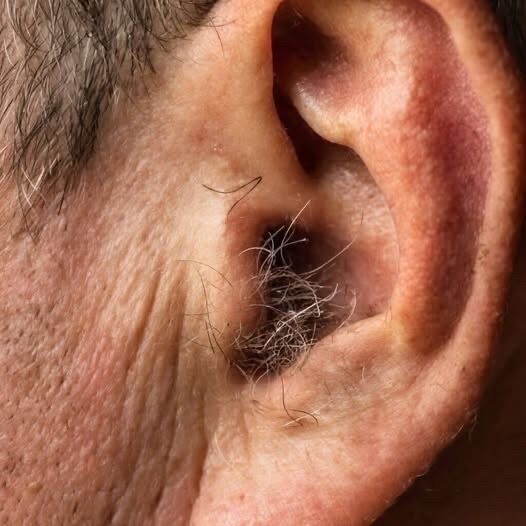
Did you know? If hair grows on your ears, it’s because your body is aging normally and responding to hormonal and genetic changes over time.That is the honest ending to the sentence—no fear, no superstition, no hidden disease. And yet, few everyday bodily changes cause as much curiosity, embarrassment, or misinformation as hair growing on the ears, especially in older adults. Many people notice it suddenly one day, often after the age of fifty or sixty, and immediately wonder whether something is wrong. Others joke about it, hide it, or quietly worry.The truth is far simpler, far more human, and far less alarming than myths suggest.
Ear hair growth is one of the most ordinary signs of aging, particularly in men, though women experience it too. It reflects how the body changes with time, hormones, and genetics—not illness, not imbalance, not decline. Understanding why it happens can replace confusion with clarity and shame with acceptance.
Aging is not a malfunction, it is a process
The human body does not age evenly. Some systems change early, others late. Hair is one of the most visible markers of this uneven process. While hair thins on the scalp, it may grow thicker in places that once seemed hairless—ears, nose, eyebrows. This paradox confuses many people, but it follows a biological logic.
Hair follicles exist across most of the body. What changes with age is how those follicles respond to hormones, particularly androgens such as testosterone and dihydrotestosterone (DHT). These hormones influence hair growth differently depending on location.
As we age, follicles in certain areas become more sensitive—not less. The ears and nose are among them.
The role of hormones in ear hair growth
Hormones are chemical messengers. Over decades, their balance shifts. Testosterone levels may decline overall, but sensitivity to its byproducts can increase in specific tissues. This is why:
Scalp hair may thin
Eyebrows may grow bushier
Nose and ear hair may become thicker and longer
It is not that the body is producing “too much” hormone. It is that the follicles are responding differently.
This phenomenon is especially common in men due to lifelong androgen exposure, but women can experience it as well, particularly after menopause when estrogen levels decline and androgen influence becomes more noticeable.
Genetics decide where hair grows
If your father, grandfather, or uncles had noticeable ear hair later in life, chances are you will too. Genetics determine:
Hair follicle density
Sensitivity to hormones
Growth cycles
Hair thickness and color
Ear hair growth often runs in families. It is not random, and it is not something you caused through diet, hygiene, or lifestyle.
Ear hair once had a purpose
From an evolutionary perspective, ear hair serves a function. It helps:
Trap dust and debris
Reduce insect entry
Protect the ear canal
In younger years, this hair is fine and barely visible. With age, the growth cycle lengthens, allowing hairs to grow longer and thicker. What was once subtle becomes noticeable.
This is not the body “failing.” It is the body continuing to do what it has always done—just more visibly.
Common myths that need to stop
There are many false beliefs surrounding ear hair. Let us address them clearly.
Myth: Ear hair means poor circulation
False. There is no medical evidence linking ear hair to circulation problems.
Myth: Ear hair indicates liver or kidney disease
False. Hair growth patterns are not diagnostic markers for organ failure.
Myth: It means hormones are dangerously imbalanced
False. It reflects normal hormonal aging, not pathology.
Myth: Removing it makes it grow back thicker
False. Hair does not grow back thicker due to shaving or trimming. That is a visual illusion caused by blunt hair ends.
Understanding these facts matters, because fear often comes from misunderstanding.